

- Case studies
In October 1927, a young British secretary named Mercedes Gleitze became the first British woman to swim across the English Channel. It was a gruelling 15-hour feat in freezing, choppy water. When another swimmer's hoax forced newspapers, officials, and the public to ask a new question: how do we know a swim is real? Gleitze decided to prove herself with a vindication swim.
This story was also the birth of Rolex's marketing genius.
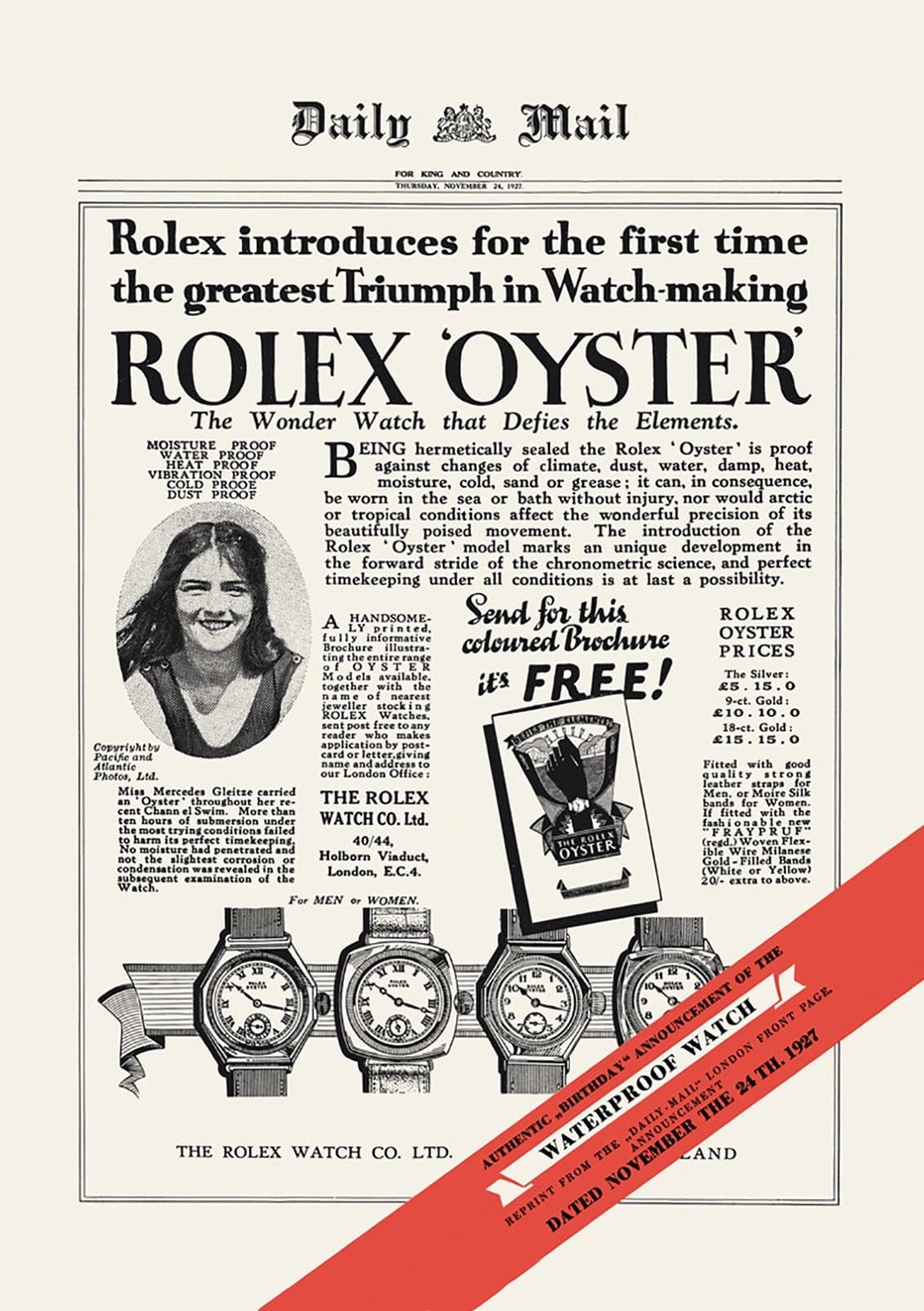
Hans Wilsdorf, the founder of Rolex, could foresee this to be a moment in history. He gave Gleitze a prototype Rolex Oyster to wear during her swim. This wasn't worn on her wrist, but on a lanyard around her neck. She made it 10 hours in brutal conditions before forfeiting the swim. The watch survived the 10 hours.
Wilsdorf bought the front page of the London Daily Mail and announced the world's first waterproof wristwatch. With that, Rolex had just invented the modern brand testimonial and successfully bridged the gap between engineering innovation and public trust.
The foundation of hidden finance
Today, most of the company's marketing stunts are very well known but one thing that flies under the radar are it’s financials. In fact, Rolex’s financials remain unpublished. The private nature of these figures is by design.
Rolex is owned entirely by the Hans Wilsdorf Foundation, a Swiss charitable trust established in 1945. This structure is legally bulletproof: Swiss law prevents the foundation from being acquired, sold, or dissolved. There are no external shareholders, no private equity oversight, and no competitors with access to their margins.
The paradox of transparency
Here's what many modern companies miss: external financial validation doesn't guarantee growth.
Many modern businesses operate under the logic that broadcasting metrics - funding rounds, user growth, revenue milestones - builds trust and attracts customers. Many growth-obsessed companies treat financial transparency as a marketing tactic, believing it justifies premium valuations and drives expansion.
Rolex proves this assumption isn't universal.
The company has built one of the world's most valuable luxury brands while revealing virtually nothing about its financial performance.
So how does secrecy lead to growth?
How secrecy becomes strategy
Financial opacity at Rolex is an active strategy to create a competitive moat, with three distinct advantages:
1. Pricing power without scrutiny: Between 2021 and 2024, Rolex raised average watch prices from CHF 11,500 to CHF 13,140, a 14% increase, while simultaneously reducing production to 1.18 million units. Without public profit disclosures, the company sidesteps accusations of price gouging. The market simply accepts that Rolex watches command higher prices.
2. Patient capital allocation: All profits flow back into the foundation, which reinvests them into product refinement, vertical integration, and brand building. There's no pressure to distribute dividends or optimise for quarterly returns. Decisions like acquiring component supplier Aegler in 2004 to control the supply chain can be made based on long-term strategic value rather than near-term earnings impact.
3. Strategic invisibility: Competitors cannot reverse-engineer Rolex's margins, cost structure, or predict its next moves. This information asymmetry acts as a moat, protecting both pricing strategy and operational decisions from competitive copying.
For finance leaders, this represents a holy trinity, long-term strategic autonomy without quarterly earnings pressures or market commentary.
The takeaway
For CFOs and finance leaders, Rolex's story reveals a fundamental truth for successful businesses: finance and treasury management aren't support functions, but growth engines.
From its inception, Rolex treated financial strategy as a core competitive advantage and by maintaining rigorous internal financial transparency while preserving external opacity, the company created the conditions for disciplined decision-making. The story wasn't about hiding numbers but not letting external pressures sway the finance function from using the those numbers strategically to focus relentlessly on what actually drives sustainable growth: quality, consistency, and long-term value creation.
Today, Rolex maintains a dominant market position, accounting for nearly 29% of total market share, more than 120 years on.
This is what happens when treasury management is treated as strategic pillars from day one, not as compliance functions bolted on later.
About Primary
Primary provides modern treasury management solutions for complete cash visibility, idle cash optimisation, and FX risk management - all in one platform.